


Preliminaries : This Practical Work uses version 3.0 of the scientific
software Scilab , developed by INRIA
and ENPC. All the installation files
can be downloaded freely from the web page
http://www.scilab.org.
The PW needs two Scilab command files
simu1.sce
and
simu2.sce, that one should store in his
working directory.

The aim of the PW is to study different harvesting policies of a stock of a renewable resource. More precisely, we consider a population
dynamics, whose stock follows a natural logistic growth law
and is harvested (by catches, picking, ...). The dynamical evolution of the stock can be written with the help of a ordinary differential equation :
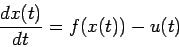
 of the system is the quantity of the stock at
time
of the system is the quantity of the stock at
time  .
.
 is the instantaneous speed of harvest at
time .
is the instantaneous speed of harvest at
time .
In order to simulate the solutions of the system under Scilab , let us start by defining the dynamics and the control, with the help of two functions
 and
and  :
:
1. For the logistic law :
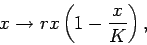 as follows :
 (intrinsic growth rate) and
  (carrying capacity), for instance
2. For the control, begin by a simple law : a constant policy, as long as the stock is non empty :
deff('[u]=har(t,x)','if x>0 then u=H; else u=0; end');
and choose a value for the constant  , say
, say
H=0.24;
For launching the simulations, enter the following instruction
exec("simu1.sce");
Then, a window appears :
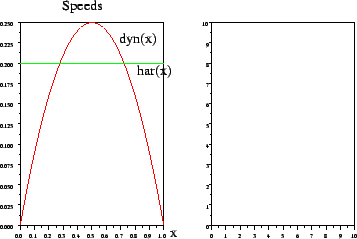
In the left, the graphs of the functions  and
and  are plotted.
Clicking on the LEFT figure launches on the RIGHT figure
the simulation of the trajectory of the dynamical system
are plotted.
Clicking on the LEFT figure launches on the RIGHT figure
the simulation of the trajectory of the dynamical system

 , chosen to be the abscissa of the mouse
position while clicking :
, chosen to be the abscissa of the mouse
position while clicking :
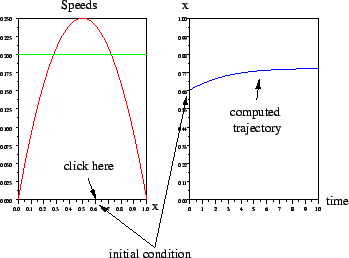
Further clicks will make different trajectories of the system superposing :
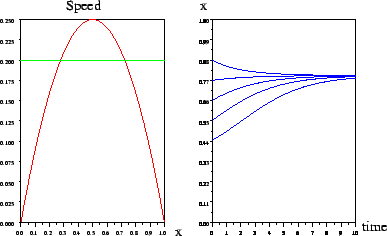
Question 1 : Study the stability of the two non-null equilibria. What is
the value  of the stock at the stable equilibrium ?
Question 2 : Redefine the control law such that there exists only
on non null equilibrium , and such that from any non null initial condition, the trajectory converges asymptotically towards . Denote
x_e=0.6;
Question 3 : We consider here that the intrinsic growth rate
fluctuates with time in the following manner :
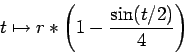
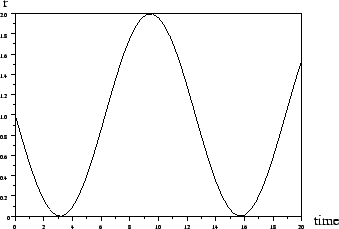 to take into account this new feature, and
simulate the behavior of the system for different initial conditions, and
the two previous control laws. What can be concluded ?
to take into account this new feature, and
simulate the behavior of the system for different initial conditions, and
the two previous control laws. What can be concluded ?
We call harvesting effort the measure of the means available for the
captures (fishermen numbers, size and number of nets, ...).
We shall assume that the harvesting speed is proportional to the stock
and the effort  at any time t :

 is a positive parameter, usually called capturability.
At the price of renormalizing the effort , we can take without loss of generality
is a positive parameter, usually called capturability.
At the price of renormalizing the effort , we can take without loss of generality  .
.
We consider now an exploitation controlled by the variations of the
harvesting effort :
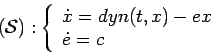
 (in caps) :

 is constrained as follows :
![\begin{displaymath}
({\cal C}) :
c(t) \in \left\vert\begin{array}{ll}
\left[-\ba...
...ft[-\bar c,0\right] & \mbox{ if } e=e_{max}
\end{array}\right.
\end{displaymath}](img30.png)
Question 4 : Prove that for such control laws, the domain
![\begin{displaymath}
{\cal D} = \left\{ \left(\begin{array}{c}x e
\end{array}\right) \vert x \in [0,K], \; e \in [0,e_{max}] \right\}
\end{displaymath}](img31.png)
 .
.
We study now possible control laws which fulfill the constraints  and stabilize the system about
  .
Three laws are considered :
.
Three laws are considered :
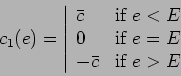
 :
:
![\begin{displaymath}
c_{2}(e)=\mbox{sat}_{[-\bar c,\bar c]}(G(e-E))
\end{displaymath}](img37.png)
![\begin{displaymath}
c_{3}(x,e)=\mbox{sat}_{[-\bar c,\bar c]}(G_{1}(x-x_{e})+G_{2}(e-E))
\end{displaymath}](img38.png)
 ,
,  and
and  are tuning parameters, and
  is the
saturation function :
is the
saturation function :
![\begin{displaymath}
\mbox{sat}_{[m,M]} : \xi \to \left\vert\begin{array}{ll}
M &...
... \xi \in [m,M]\\
m & \mbox{if } \xi \leq m
\end{array}\right.
\end{displaymath}](img43.png)
Define
H=0.24;x_e=0.6;E=H/x_e;cbar=0.1;
For the simulations, consider that is again constant, which amounts to
define the dynamics as follows :
deff('[y]=dyn(t,x)','y=r*x*(1-x/K)');
The control law is defined in Scilab with the help of the function  .
For instance, for the ``bang-bang'' law :
.
For instance, for the ``bang-bang'' law :
epsilon=1e-3;
deff('[edot]=com(t,X)','e=X(2);..
if abs(e-E)< epsilon then edot=0;..
else edot=cbar*sign(E-e); end');
Simulations are launched entering the instruction
exec("simu2.sce");
A window then appears :
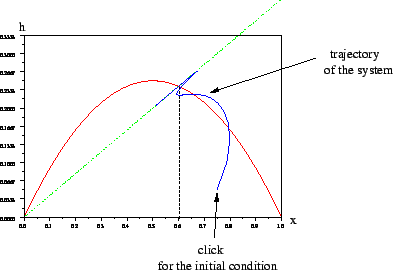
 ,
computes and represents the generated trajectory of the system
,
computes and represents the generated trajectory of the system

 with
with  .
.
Question 5 :
Simulate the control law  . What happens if one takes
epsilon=0 ?
. What happens if one takes
epsilon=0 ?
Question 6 :
Write in Scilab the control law  , and simulate the trajectories
taking different values of the gain between
, and simulate the trajectories
taking different values of the gain between  and
and  .
Explain the qualitative behaviors ?
.
Explain the qualitative behaviors ?
Question 7 :
Write in Scilab the control law  , and simulate the trajectories
taking different values of the gains and . Determine
analytically the pairs
, and simulate the trajectories
taking different values of the gains and . Determine
analytically the pairs  insuring a local asymptotic
stability of the closed loop system.
insuring a local asymptotic
stability of the closed loop system.
With the option :
linearise='on';
activated, entering the instruction exec("simu2.sce"); computes
and draws (in dashed lines) in addition the trajectory of the system
linearized about , in the plane :
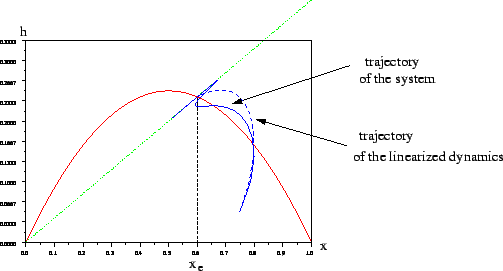
Question 8 : Launch gain the simulations of the different control laws,
together with the drawing of the trajectories of the linearized dynamics
What can be concluded ?
Practical Work sheet prepared by Pierre Cartigny and Alain Rapaport.